
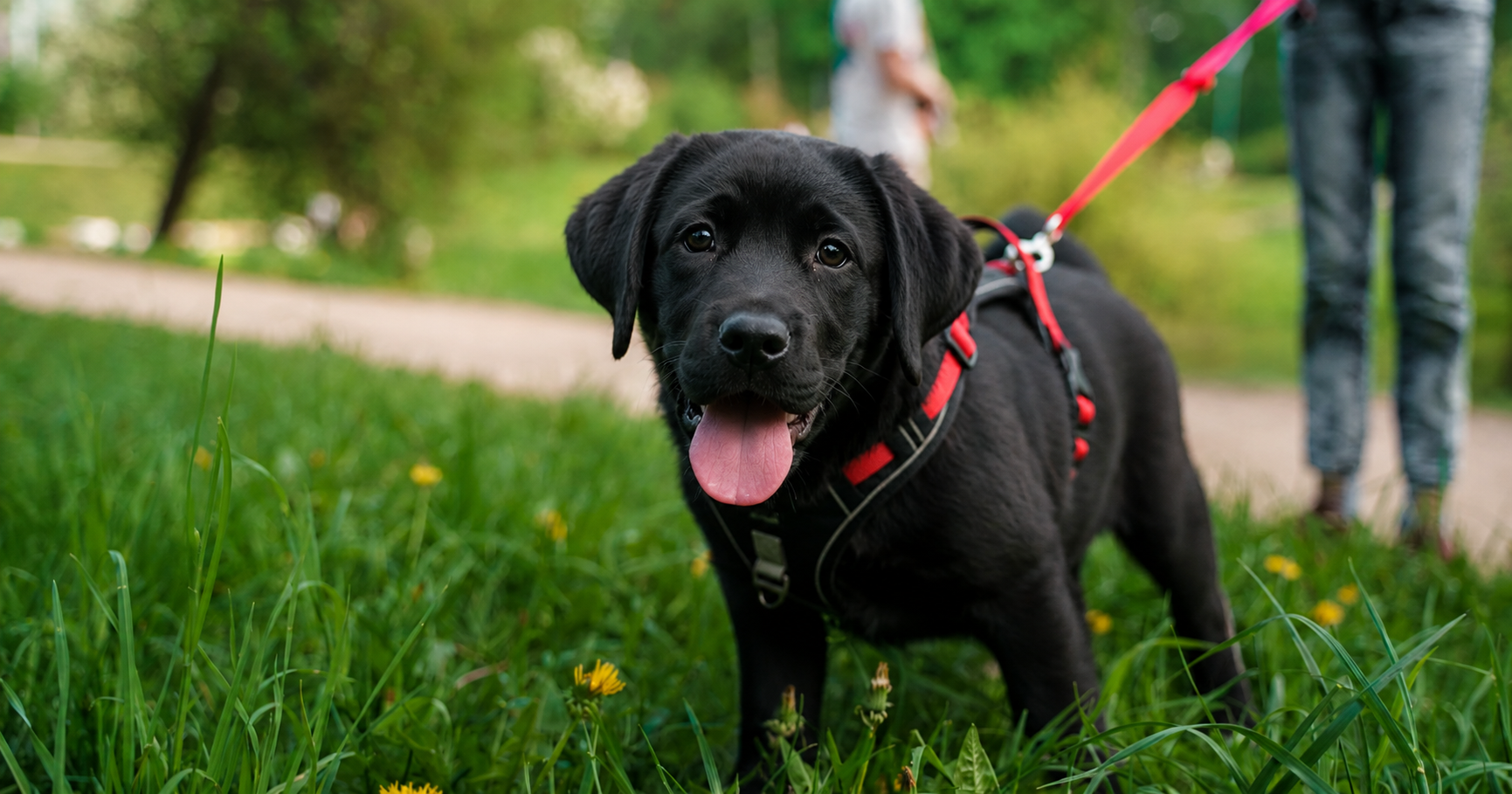
New Year’s Dog Training Resolutions That Actually Stick

Every January, the same thing happens: new calendar, new energy, and a very strong urge to announce, “This is the year my dog finally stops doing that.” You sign up for a class, buy a treat pouch, maybe even make a color-coded dog training schedule. Then February hits. It is dark at 5 PM. Your dog discovers a new hobby (screaming at the doorbell, perhaps). Your motivation drops off a cliff.

If you’ve ever felt like you’re “starting over” every New Year, you’re not alone, and it does not mean you lack discipline. It usually means your goal was too vague, too big, too dependent on willpower, or built on training myths (like “my dog should know better by now”).

Here’s the reframe that makes resolutions actually work: we are not “fixing” your dog. We are building habits, changing outcomes, and making the environment do more of the heavy lifting. Dogs repeat what works. If pulling gets them to the sniffy fire hydrant, pulling will keep happening. If barking makes the scary thing go away, barking will keep happening. Your job is not to “win” a power struggle. Your job is to make the behavior you want the most rewarding option in real life.

This post gives you:

  • A simple framework for choosing dog training goals that are realistic and measurable

  • 10 New Year’s dog training resolutions (pick one or two)

  • A 30-day structure that turns good intentions into automatic habits

  • Troubleshooting for the mistakes that derail most training plans

If you only read one thing: choose 1–2 goals and train 3–5 minutes a day. Small wins stack faster than giant weekend “catch-up” sessions.

If you want hands-on help (especially in NYC), Shelby Semel Dog Training focuses on humane, reward-based training that builds real-world skills and a relationship you actually like living in. Start here.

The Resolution Framework: How Dogs Actually Learn (so your goals aren’t doomed)

Before we talk goals, you need one truth that will save you months of frustration:

Dogs are always learning. Not just in “training sessions.” Every walk, every doorbell ring, every time your dog drags you to a bush and you follow, a lesson is happening.

Two learning processes explain most of what you see at home:

Operant conditioning (behavior changes based on consequences)

This is the “what gets rewarded repeats” system. Reinforcement makes a behavior more likely in the future. Punishment makes a behavior less likely. (Important: in behavioral science, “positive” and “negative” mean adding or removing something, not “good” or “bad.”)

  • If your dog jumps and gets attention, jumping is reinforced.

  • If your dog pulls and gets to the park faster, pulling is reinforced.

  • If your dog lies on a mat and gets calm treats (or access to chew time), settling is reinforced.

Classical conditioning (emotions and associations change through pairing)

This is the “trigger predicts feelings” system. Doorbell predicts chaos. Other dogs predict tension. The harness predicts adventure. With classical conditioning, you are changing the emotional meaning of a thing, not just the behavior around it.

Why this matters for New Year’s goals:

  • If your dog is reactive, fearful, or anxious, you often need emotion change plus skill-building.

  • If your dog is labeled “stubborn,” it is usually a reinforcement-history problem, not a personality flaw.

A helpful example: doorbell chaos often persists because the doorbell predicts exciting things, your dog practices the meltdown, and the meltdown is accidentally reinforced (people talk to the dog, push the dog, chase the dog, or open the door during the chaos). Once you see the learning loop, you stop blaming your dog and start designing a better loop.

If you want a training philosophy that aligns with what behavioral science and veterinary behavior organizations recommend, reward-based training is the gold standard for both welfare and effectiveness.

For a Shelby-focused refresher on what positive reinforcement training means in real life, check out this blog

Step 1 — Pick the Right Goal (SMART, but for dogs)

Most resolutions fail because they are not specific enough to train.

“Stop barking.”
“Be better on walks.”
“Be calm.”

Those are feelings, not behaviors.

Instead, use DOG-SMART goals:

  • Define the behavior (what will your dog do, specifically?)

  • Observable and measurable (how will you know it happened?)

  • Gradual (increase criteria in tiny steps)

  • Setup first (change the environment before expecting perfection)

  • Motivation-based (what does your dog work for?)

  • Access to reinforcement controlled (you decide when the payoff happens)

  • Real-life reps (practice where it matters)

  • Time-bound (30 days, not “forever”)

Callout: Don’t set a resolution that depends on willpower alone. Set one that depends on setup.

Example DOG-SMART goal:

“For the next 30 days, my dog will go to a mat when I sit down to eat dinner, and stay there for 2 minutes while I reward calm behavior.”

That is trainable. “Be polite” is not.

If you want professional help translating “my dog is a chaos goblin” into a real training plan, SSDT private sessions are designed for exactly that kind of real-world customization. 

Step 2 — Your Dog’s Body Language Is the Progress Report

People are listeners. Dogs are watchers.

Your dog is giving you feedback constantly, and your training plan should change based on that feedback. You are not just looking for obedience. You are looking for learning plus emotional safety.

What to watch during training

Green (keep going):

  • loose, wiggly body

  • soft face, easy breathing

  • able to take treats normally

  • quick recovery after surprises

Yellow (pause or make it easier):

  • lip/nose licking, yawning (when not tired)

  • “shake off,” sudden sniffing, darting eyes/head swivels

  • slower response to cues

  • taking treats roughly or stopping treats altogether

Red (stop and back up):

  • stiff body, hard stare

  • growling, lunging, freezing

  • frantic scanning, inability to disengage

  • refusing food consistently in a context where they normally eat

Purdue’s Canine Welfare Center summarizes these stress and “calming signal” behaviors well, including lip licking, yawning, and shaking off as signs that a dog may be unsure or uncomfortable.

Why it matters: if your dog looks worse over repetitions, you may be sensitizing, not helping. In other words, you are practicing stress.

Your “resolution” should include one non-negotiable rule:

If body language deteriorates, we reduce difficulty immediately.

The 10 New Year’s Dog Training Resolutions (Pick 1–2)

Each resolution below includes:

  • What success looks like

  • Why it’s hard

  • 3–5 daily reps

  • Common mistakes

  • How to track progress

If you want more structured support, SSDT also offers group classes (including puppy-focused and city-life skills).

Resolution #1 — Train a “Settle” (Calm is a Skill)

What success looks like

Your dog relaxes on a mat/bed for X minutes while life happens: you eat, you work, you answer email, you talk to a friend.

Why it’s hard

Most dogs only rehearse “calm” when they are exhausted. Calm needs reps the same way sit does.

3–5 daily reps

  1. Capture calm: when your dog is lying down quietly, drop a treat between their paws.

  2. Mat = good things: feed on the mat, give chews on the mat, toss treats onto the mat.

  3. Add duration: reward calm every few seconds, then slowly increase time between rewards.

  4. Add tiny life moments: stand up, sit down, open a cabinet, then reward if calm continues.

Common mistakes

  • Only practicing when your dog is already wired.

  • Moving too fast (jumping from “quiet room” to “guests arrived”).

Track progress

  • Daily: “minutes settled during dinner” or “number of calm mat reps.”

  • Weekly: one 20-second before/after video clip.

Internal reading that pairs well with this mindset: “consent” and cooperative care principles translate beautifully into “settle” work because they prioritize choice and emotional safety: 

Resolution #2 — Leash Walking Without a Power Struggle

What success looks like

Not perfect heels. Real success is:

  • fewer leash-tight moments

  • faster recovery after excitement

  • more check-ins and easier turns

Why it’s hard

The environment is reinforcing. NYC sidewalks, squirrels, smells, other dogs, delivery bikes: your dog is being paid in real time.

3–5 daily reps

  1. Reinforce slack leash: mark (yes/click) the instant the leash goes slack, then reward near your leg.

  2. “Let’s go” U-turns: practice quick happy turns away from distractions, then pay.

  3. “Find it” scatter: toss treats on the ground to help decompress and reset arousal on walks.

  4. Premack payments: polite walking earns access to sniffing. (“Yes… go sniff.”)

Common mistakes

  • Waiting until your dog is already pulling to address it.

  • Treating “sniffing” like a problem instead of a powerful reinforcer you can use strategically.

Track progress

  • Count “tight leash incidents per block” for one consistent route.

  • Rate each walk 0–2: 0 = chaos, 1 = manageable, 2 = pleasant.

Resolution #3 — A Reliable Recall (Come When It Counts)

What success looks like

Your dog turns on a dime:

  • inside the home

  • in quiet outdoor spaces on a long line

  • around moderate distractions (before you ever risk off-leash)

Why it’s hard

Most people accidentally poison the cue. “Come” often predicts the end of fun, a bath, nail trims, or leaving the park.

3–5 daily reps

  1. Five rapid-fire recalls at home: short distance, happy voice, pay fast.

  2. Jackpot reinforcement: 1–2 reps per day get a “big payday” (multiple treats, tug, whatever your dog loves).

  3. Collar grab = treat: gently touch collar, feed treat, repeat. This builds a safety reflex for real-life moments.

  4. Recall games: ping-pong between people, hide-and-seek, and “treat & retreat.”

SSDT’s recall ladder and long-line guidance (including scaling to elevators, stoops, and parks) is worth bookmarking:

Common mistakes

  • Calling only to end fun.

  • Repeating the cue over and over while your dog ignores it (you are training them to ignore you).

Track progress

  • “Seconds to turn toward me” after the cue (aim to reduce).

  • “Recall success rate” in three contexts: home, hallway/lobby, outdoors on long line.

Resolution #4 — Polite Greetings (No More Launching at People)

What success looks like

Four paws on the floor (optional sit). Greeting access becomes the reward.

Why it’s hard

Jumping works. Dogs jump because it reliably produces attention, touch, laughter, eye contact, or movement.

3–5 daily reps

  1. Teach an incompatible behavior: “sit” or “go to mat” before greeting.

  2. Use greetings as payment: calm behavior opens the door to hello.

  3. Short scripted practice: ask a friend to approach, pause, retreat, repeat.

  4. Reinforce calm with food + access: treat for four paws down, then “go say hi.”

Common mistakes

  • Accidentally reinforcing jumping with any attention (even “no,” pushing, or eye contact).

  • Letting greetings happen at full intensity before your dog has reps.

How to track

  • “Successful greetings per week” (define success as four paws down for 2 seconds).

  • Bonus: track how quickly your dog can recover from excitement.

Resolution #5 — “Leave It” and “Drop It” Without Drama

What success looks like

Your dog disengages from an item and reliably trades, even when the item is interesting.

Why it’s hard

People rush to “proofing” with high-value items too early, then the dog learns that humans approaching predicts losing things.

3–5 daily reps

  1. Start low-value: boring item on the floor, reward for looking away.

  2. Trade up: offer a better treat, then give the item back sometimes to build trust.

  3. Build an automatic “spit reflex”: play tug, say “drop,” trade for treat, resume tug.

  4. Practice in real life: use “leave it” for sidewalk snacks with distance first.

Common mistakes

  • Chasing your dog (makes it a game).

  • Forcing items out of the mouth (teaches guarding risk in some dogs).

Track progress

  • “Percent success” at three difficulty levels: boring, medium, high.

  • “Latency” (how fast your dog disengages).

Resolution #6 — Cooperative Care (Grooming/Vet Handling Without a Fight)

What success looks like

Your dog opts in to handling: paws, ears, brushing, gentle restraint, and vet-style body checks.

Why it’s hard

Handling is often rushed, unpredictable, and paired with stress. Dogs learn to anticipate discomfort.

3–5 daily reps (60 seconds can be enough)

  1. Consent start button: teach a position that means “I’m ready” (chin rest, paw target, standing still).

  2. Touch, treat, stop: one gentle touch, treat, then stop before stress builds.

  3. Upgrade slowly: touch paw, treat; touch nail, treat; bring clippers near, treat.

  4. Pair equipment with good things: brush appears, treat rains, brush disappears.

SSDT frames cooperative care explicitly as a positive reinforcement subset where dogs participate in their own care:

Common mistakes

  • Marathon grooming sessions that push the dog into “red zone” stress.

  • Ignoring early stress signs like lip licking, yawning, or freeze responses.

Track progress

  • “How many seconds of calm brushing” or “how many paw touches with relaxed body language.”

Resolution #7 — Reduce Barking by Solving the “Why”

What success looks like

Less barking, faster recovery, and a dog who can do an alternate behavior when triggered.

Why it’s hard

“Stop barking” does not tell your dog what to do instead, and barking is often self-reinforcing or fear-based.

Identify the category

  • Alert barking: “something changed!”

  • Demand barking: “do a thing for me!”

  • Fear/reactivity barking: “that’s too close!”

3–5 daily reps (matched to the function)

  1. Teach an alternate behavior: “go to mat,” “find it,” or “touch.”

  2. Manage triggers: block window access, add white noise, control visual exposure.

  3. Change emotion for fear-based barking: pair the trigger at a safe distance with high-value reinforcement (tiny, consistent).

  4. Reinforce quiet moments: mark quiet, pay quiet.

Common mistakes

  • Waiting until barking is full intensity, then trying to “train through it.”

  • Punishing fear-based barking, which can suppress warnings without resolving fear.

Track progress

  • “Number of barking episodes per day.”

  • “How fast does the dog recover” (minutes down to seconds is a real win).

Resolution #8 — Build Better Alone-Time Skills (Separation-Related Behaviors)

What success looks like

Calmer departures, less distress behavior, and a predictable routine around leaving.

Why it’s hard

Many people make leaps that are too big. A dog who panics at 30 seconds does not learn from 30 minutes.

3–5 daily reps

  1. Micro-absences: step out for 3 seconds, return calmly. Repeat.

  2. Neutral cues: pick up keys, put them down, treat, no departure.

  3. Safe enrichment pairing: special chew or stuffed toy only appears during alone-time practice.

  4. Calm returns: no big “I’m back!” party; keep it boring so leaving is not a tragedy.

SSDT offers a dedicated virtual separation anxiety package for structured support and pacing.

Common mistakes

  • “Testing” your dog by leaving longer than they can handle.

  • Flooding (long exposure) instead of gradual exposure, which veterinary behavior organizations caution against.

Track progress

  • “Longest calm absence” (seconds/minutes) with relaxed body language.

  • Keep a simple log of duration and behavior.

Resolution #9 — Daily Enrichment (So Your Dog Stops Inventing Their Own Fun)

What success looks like

Less nuisance behavior, more calm, and a dog who can settle because their needs are met.

Why it’s hard

Enrichment is often treated like “extra.” For many dogs, it is the foundation that makes training possible.

3–5 daily reps (choose 1–2 per day)

  1. Puzzle feeding: part of dinner in a snuffle mat or puzzle toy.

  2. Sniff walk: 10 minutes where your dog leads (within safety), sniffing is the point.

  3. Shredding box: cardboard box + safe paper + treats hidden inside.

  4. Toy rotation: fewer toys out, rotate weekly to keep novelty high.

  5. Training as enrichment: 3 minutes of “touch,” “spin,” “mat,” “find it.”

Toy safety matters. SSDT’s toy guide includes veterinarian input on hardness (avoid tooth-breakers) and appropriate sizing (avoid obstruction hazards):

Common mistakes

  • Giving a “forever” chew unsupervised when your dog is not safe with it.

  • Assuming high-energy dogs need only more physical exercise (many also need more decompression and sniffing).

Track progress

  • Rate your dog’s evening behavior 0–2 (0 = chaotic, 2 = calm).

  • Note enrichment type used that day.

Resolution #10 — Social Skills and Neutrality (Not “Be Social,” Be Stable)

What success looks like

Your dog can pass dogs and people without escalating. Greetings are optional, not mandatory.

Why it’s hard

Many dogs are pressured into social contact that overwhelms them. “Socialization” is not the same as “interaction.”

3–5 daily reps

  1. Reward neutrality: mark and treat for noticing a dog/person and staying loose.

  2. Parallel walks: walk near another dog at a safe distance, no greeting required.

  3. Short planned greetings: only if both dogs show relaxed, affiliative signals.

  4. Exit skills: practice U-turns and “find it” to leave calmly.

Common mistakes

  • Flooding: forcing proximity until the dog “gets used to it.”

  • Interpreting overstimulation as friendliness.

Track progress

  • “Distance at which my dog stays in green zone.”

  • “Number of calm passes per walk.”

The 30-Day Resolution Plan (Make it Automatic)

A dog training schedule that works is boring on purpose. The goal is not intensity. The goal is consistency.

Week 1: Setup + easy wins

  • Pick 1–2 goals.

  • Choose reinforcers (treats, tug, sniffing, access).

  • Choose training moments you already do (after coffee, before dinner, after the first walk).

  • Remove friction: treats pre-portioned, leash by the door, mat already placed.

If your training method relies on intimidation or “showing who’s boss,” it tends to create fallout and stress. Reward-based methods are strongly supported by veterinary behavior organizations for welfare and long-term effectiveness.

Week 2: Add one layer of difficulty

Only change one of the “three D’s” at a time:

  • Duration

  • Distance

  • Distraction

Example: if your settle is good for 30 seconds, do not also add guests and a doorbell. Add one element.

Week 3: Generalize

Practice in new places:

  • new rooms

  • hallway/lobby

  • sidewalk outside your building

  • quiet corner of a park

Skills that only work in your living room are not “broken.” They are un-generalized.

Week 4: Make it real life

Practice in the moments you actually need:

  • before guests arrive

  • before elevator doors open

  • before you step into the lobby

  • before you unclip the leash in a fenced area

Tracking tools (simple, not fancy)

  • 1-minute daily log: rate the day 0–2 and write one sentence.

  • Weekly before/after clip: 20 seconds each.

  • One measurable metric per goal: “tight leash moments,” “successful greetings,” “minutes settled.”

If you want someone to build this into a custom training plan for your household, private sessions (in-person or virtual) are designed around exactly this kind of practical structure.

The 5 Mistakes That Ruin Dog Training Resolutions (and the fixes)

  1. Too many goals at once
    Fix: 1–2 goals, 3–5 minutes a day.

  2. Raising criteria too fast
    Fix: smaller steps; change one variable at a time.

  3. Reinforcing accidentally (especially with attention)
    Fix: control access to reinforcement (attention, greeting, movement, sniffing).

  4. Training over-threshold (stress rising)
    Fix: read body language and back up. Stress signals like lip licking, yawning, and “shake off” matter.

  5. Inconsistency across humans
    Fix: household rules + one-page plan on the fridge.

When to Get Professional Help (and why it’s not “failing”)

You should seek professional support if you’re dealing with:

  • bites or attempted bites

  • escalating aggression

  • intense panic (especially alone-time distress)

  • compulsive behaviors

  • reactivity that is worsening over time

The reason is not shame. It’s precision. With behavior problems, the wrong plan can accidentally sensitize your dog and make the issue harder. Veterinary behavior guidance emphasizes welfare, safety, and gradual, systematic work rather than force-based techniques.

If you’re in NYC (or want virtual support), start here:

Conclusion: Pick One Goal and Start Today

Your dog does not need a “New Year, New Dog” fantasy. Your dog needs small daily reps, smart setup, reinforcement that makes sense, and a plan that fits your life.

Progress is often quieter than you expect: fewer leash-tight moments, faster recovery, one calmer greeting, a mat settle that lasts through half your meal. Those wins count. They compound.

Pick one resolution. Train 3–5 minutes today. Then do it again tomorrow.

Optional Add-Ons (FAQ + Printable Worksheet + NYC Variant)

FAQ

How long does it take for dog training to “stick”?

It depends on the behavior, your consistency, and how reinforcing the environment is. The goal of the 30-day plan is not perfection. It’s building momentum and a repeatable training schedule. Behavior change is learning plus repetition plus generalization.

What treats should I use?

Use something your dog will actually work for. Soft, smelly treats tend to be more effective for distraction-heavy environments. If you’re working on fear or reactivity, the “payment” often needs to be higher value than you think.

What if my dog isn’t food-motivated?

First, check whether your dog is over-threshold. Many dogs “lose” food motivation when stressed. Second, broaden reinforcement: toys, tug, praise, access to sniffing, greeting, or movement can all function as reinforcers. “The world” can be the reward if you control access to it.

Is punishment ever part of training?

In learning theory, “punishment” means decreasing behavior, and “negative punishment” is removing something pleasant to reduce a behavior (example: attention goes away when jumping happens).
Even when used thoughtfully, punishment does not teach your dog what to do instead. That is why humane training focuses heavily on reinforcement and skill-building, with management and clear reinforcement access.

How do I know if my dog is stressed?

Look for displacement and calming signals like lip licking, yawning, shaking off, darting eyes/head swivels, and stiffness. If these increase, reduce difficulty and create more distance.